



At the moment, there are no entries available for display



GRI
2-9
DFCC Bank’s sustainability journey has evolved significantly since the launch of its inaugural 10-year Sustainability Strategy in 2020, which laid the foundation for strengthening resilience across the Bank’s operations, stakeholders and communities. In response to rapid advancements in global sustainability standards, the growing focus on ESG integration, and the emergence of new due-diligence and disclosure requirements, the Bank initiated a comprehensive reassessment of its sustainability approach.
In 2025, DFCC Bank completed an independent gap analysis of its sustainability reporting and strategic alignment, enabling a detailed review of existing processes, stakeholder engagement mechanisms, and reporting frameworks. The findings guided enhancements to the Bank’s governance architecture, including the revision of the ESG Policy, the introduction of a dedicated ESG Risk Policy integrating Sustainability-related Risks and Opportunities (SRROs) into the Integrated Risk Management Framework (IRM), and updates to the Environmental and Social Management System (ESMS) to reflect evolving local and international expectations.
DFCC Bank's Sustainability Governance
DFCC Bank’s sustainability governance framework is an integrated model that enables DFCC Bank to deliver responsible growth while upholding transparency, resilience, and long-term value creation for all stakeholders.
| Board/Committee | Overview to the roles and responsibilities related to sustainability governance |
| Board Level | |
| Board of Directors |
|
| Board Integrated Risk Management Committee (BIRMC) |
|
| Management Level | |
| Executive Sustainability Management Committee (ESMC) |
|
| Credit Committee |
|
| Sustainability Management Committee (SMC) |
|
| Operational Level | |
| Sustainability Department |
|
| Marketing Department (CSR Function) |
|
In 2025, DFCC Bank further strengthened the operationalisation of its Sustainability Strategy by enhancing the effectiveness of its specialised working groups, which have been active since the strategy formulation. Through these coordinated working groups, ESG integration was embedded more deeply across functions, enabling agile execution, improved data capture, and enhanced alignment with evolving disclosure standards and regulatory requirements.
| Working Group | Tasks allocated |
| Green Finance Subcommittee |
|
| Sustainable Entrepreneurship Subcommittee |
|
| Facilities and Energy Efficiency Subcommittee |
|
| Paper Reduction Subcommittee |
|
| HR Sustainability and DEI Subcommittee |
|
For further details on sustainability governance please refer to the Governance section (pages 205-238) and SLFRS Sustainability related Disclosures section (pages 161-203) of this report.
DFCC Sustainability Framework
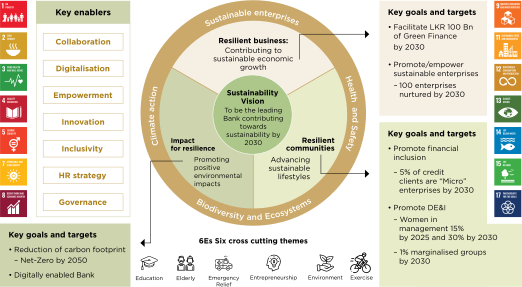
At DFCC Bank, sustainability is not a parallel agenda; it is integral to how we execute strategy and create value. Our approach is guided by a Sustainability Framework built around three core pillars; Resilient Business, Impact for Resilience and Resilient Communities. This framework integrates environmental, social and governance (ESG) priorities into core banking activities and stakeholder outcomes.
This framework operates within an integrated model, ensuring every decision is linked to the six capitals and disclosed cohesively in this report.
Strategic pathways that deliver our sustainability ambition
To support clarity and ease of navigation within this Report, DFCC Bank’s sustainability approach is organised into four strategic pathways. Each pathway demonstrates how the Bank’s three pillar Sustainability Framework connects with the Six-Capitals value creation model, contributes to relevant Sustainable Development Goals (SDGs), and aligns with the measurable targets outlined in DFCC Bank’s Sustainability Strategy.
| DFCC Sustainability strategic pathway | What it means for DFCC | 2025-2030 Focus | Linkage to six capitals |
Linkage to UN SDGs |
| Resilient Business – Financial Resilience and Business Growth | Prudent, balanced growth with ESG-aware lending and Investments to ensure stability across cycles. |
|
|


|


| DFCC Sustainability strategic pathway | What it means for DFCC | 2025-2030 Focus | Linkage to six capitals |
Linkage to UN SDGs |
| Impact for Resilience – Climate Action and Natural Capital Stewardship | Reducing DFCC’s carbon footprint while enabling climate solutions through green financing. |
|
|


|
| Resilient Communities – Inclusion, Enterprise and Community Resilience | Broaden access to products and services, empower MSMEs and women-led enterprises, delivering the 6Es CSR agenda for community resilience. |
|
|


|
| People, Culture and Digital Enablement – Cross cutting enablers | Building a high performing, inclusive workforce and digital capabilities to support DFCC’s strategic ambitions. |
|
|

|

DFCC Sustainability Pledge
DFCC Bank’s Sustainability Pledge reflects our shared commitment to caring for the planet, upholding respect and dignity in all interactions, and contributing meaningfully to the wellbeing of communities. Through this pledge, our employees commit to caring for the environment and all living beings, supporting the Bank’s sustainability goals and national resilience agenda, and acting with dignity, respect, and integrity in everyday interactions.
It reinforces the Bank’s responsibility to reduce environmental impact, support vulnerable groups, and make responsible, values-driven choices.
Together, these principles reflect DFCC Bank’s long-standing commitment to responsible citizenship and reaffirm that every member of the DFCC family plays an important role in protecting the environment, supporting communities, and contributing to a more resilient and sustainable future for all.

DFCC Sustainability Pledge
Contribution to the United Nations Sustainable Development goals
DFCC Bank contributes to the United Nations Sustainable Development Goals (UN SDGs/SDGs), reflecting its commitment to creating economic, social and environmental value through the Bank’s three core pillars of sustainability. Through responsible financing, strengthened sustainability governance, enhanced environmental and social risk management and community-focused initiatives, DFCC contributes to national development priorities and global sustainability outcomes.
| UN SDG | DFCC Supportive Activities | Reference |
|---|---|---|

|
|

|

|
|

|

|
|
|
|
|
|
|
|
|
|
|
| UN SDG | DFCC Supportive Activities | Reference |
|---|---|---|

|
|
|
|
|
|
|
|
|
|

|
|
|
|
|
|
|
|
|
| UN SDG | DFCC Supportive Activities | Reference |
|---|---|---|
|
|
|
|
|
|
|
|
|
|
|
|

|
|
|
| UN SDG | DFCC Supportive Activities | Reference |
|---|---|---|
|
|
|
|

|
|

|

|
|
|
DFCC Bank’s Commitment to the UN Global Compact Principles
DFCC Bank remains firmly committed to upholding the Ten Principles of the United Nations Global Compact (UNGC), which guide businesses worldwide in advancing human rights, labour standards, environmental stewardship, and anti-corruption practices. As a responsible financial institution, DFCC Bank integrates these principles into its governance structures, operational practices, risk frameworks, and strategic decision making processes. This alignment strengthens the Bank’s sustainability agenda, drives ethical and transparent business conduct, and reinforces its role in supporting Sri Lanka’s transition towards an inclusive, green, and resilient economy. Through consistent implementation, continuous monitoring, and stakeholder engagement, DFCC Bank ensures that the UNGC principles remain embedded in its day-to-day operations while contributing to long-term value creation for employees, customers, communities, and the nation.
Principle 1
Support and respect the protection of internationally proclaimed human rights
DFCC Bank is committed to upholding internationally recognised human rights across its operations, value chain, and stakeholder relationships. The Bank integrates human rights considerations into its corporate governance framework, HR policies, operational procedures, and risk management systems to ensure fairness, dignity, and equality for all employees and stakeholders.
Within the workplace, DFCC Bank fosters a safe, inclusive, and non-discriminatory environment supported by robust policies on equal opportunity, anti-harassment, grievance handling, and diversity and inclusion. Regular assessments on employee well-being, occupational health and safety, and workplace culture help the Bank maintain alignment with global standards and support continuous improvement.
The Bank contributes to improved livelihoods, equitable economic participation, and expanded access to financial services through targeted initiatives such as MSME development, women-focused entrepreneurship programmes, financial inclusion, and community empowerment.
These collective efforts underscore DFCC Bank’s commitment to protecting and respecting human rights while fostering broader social progress and inclusive economic development.
Principle 2
Ensure businesses are not complicit in human rights abuses
DFCC Bank maintains strict policies, controls, and due diligence mechanisms to ensure it is not, directly or indirectly, complicit in human rights abuses. The Bank’s governance structure incorporates strong oversight mechanisms through Anti-Money Laundering (AML), and Know Your Customer (KYC) frameworks to prevent financial crimes that may be linked to human rights violations.
In addition, the Bank integrates Environmental and Social (E&S) safeguards and broader ESG criteria into its lending and investment decision-making processes. These measures ensure that entities receiving financial support comply with ethical business practices, environmental responsibility, and social protection standards. DFCC Bank avoids financing businesses engaged in or associated with forced labour, child labour, discrimination, unsafe working conditions, or other forms of human rights misconduct.
Transparent disclosures, stakeholder engagement, responsible banking practices, and continuous monitoring further reinforce the Bank’s stance against human rights abuses. Through these commitments, DFCC Bank ensures its operations and partnerships uphold integrity, accountability, and respect for global human rights principles.

Principle 3
Uphold the freedom of association and the effective recognition of the right to collective bargaining
DFCC Bank is committed to upholding employees’ rights to freedom of association and collective bargaining in line with Sri Lankan labour regulations and international conventions. The Bank maintains a transparent, collaborative, and respectful approach to employee relations, ensuring that staff are empowered to express concerns and participate in formal representation structures where applicable.
DFCC’s HR governance framework includes structured employee engagement platforms, open‑door communication channels, and formal grievance‑handling procedures that promote constructive dialogue between employees and management. Through these mechanisms, the Bank strengthens trust, fosters inclusivity, and ensures that employees’ voices are heard in matters relating to workplace conditions, benefits, and well-being.
Principle 4
Elimination of all forms of forced and compulsory labour
DFCC Bank upholds a zero-tolerance policy toward forced or compulsory labour including the businesses it finances and among its partners through ensuring E & S compliance under ESMS. All employment practices comply with the labour standards, ensuring that every employee works voluntarily under fair, transparent, and legally compliant terms of employment.
The Bank’s recruitment and HR processes include thorough verification, due diligence, and audit mechanisms to ensure ethical hiring and the prevention of exploitative labour practices across operations. Through continuous monitoring and policy enforcement, DFCC Bank safeguards the rights and dignity of all employees.

Principle 5
Effective abolition of child labour
DFCC Bank upholds a zero-tolerance policy for child labour including the businesses it finances and among its partners through ensuring E & S compliance under ESMS. The Bank adheres strictly to national laws regarding minimum working age requirements, ensuring that no individuals below the legal age are employed directly or indirectly.
Beyond compliance, DFCC Bank contributes to the broader elimination of child labour by supporting education, youth empowerment, and community development initiatives. Through financial inclusion, scholarship schemes, and social responsibility programmes, the Bank helps address socio-economic challenges that can contribute to child labour, supporting long-term community resilience and youth advancement.
Principle 6
Elimination of discrimination in respect of employment and occupation
DFCC Bank is dedicated to maintaining a fair, inclusive, and non‑discriminatory workplace where all employees are treated with dignity and respect. The Bank’s policies explicitly prohibit discrimination based on gender, ethnicity, religion, disability, age, or any other protected characteristic across recruitment, career progression, training, and remuneration.
DFCC Bank promotes equal opportunity and cultivates an equitable work culture through structured training programmes on diversity, inclusion, and unconscious bias. The Bank also supports women’s empowerment by facilitating leadership development opportunities and strengthening female representation in managerial and decision‑making roles. These initiatives reflect DFCC Bank’s commitment to fostering a diverse and empowered workforce aligned with global best practices.
Principle 7
Businesses should support a precautionary approach to environmental challenges
DFCC Bank adopts a precautionary approach to environmental management by integrating robust environmental and social risk assessments into its lending and investment decisionmaking processes. The Bank’s credit evaluation framework ensures that high value/high impact projects are screened against the Bank’s Environmental and Social Management System along with national environmental regulations and international standards where applicable. This approach enables DFCC to identify, mitigate, and manage environmental risks proactively, thereby safeguarding eco-systems and supporting responsible development.
In line with its commitment to sustainable finance, DFCC has expanded its portfolio of green and sustainability-linked financial products. These initiatives encourage clients to adopt eco-friendly practices while contributing to national transition towards a low-carbon and climate resilient pathway.
Principle 8
Undertake initiatives to promote greater environmental responsibility
Being a growing Bank, we understand that it's a challenge to minimise the organisational carbon footprint. However, DFCC Bank actively works to manage its organisational footprint by investing in resource-efficient infrastructure, energy saving technologies, paperless processes and digitalisation, recycling initiatives etc. while fostering a culture of environmental responsibility across the Bank. Employee awareness and capacity building initiatives covering the topics related to climate change, circular economy and sustainable work practices that help integrate environmental responsibility into DFCC’s corporate culture. The Bank’s ‘Sustainability Pledge’ encourages employees to adopt environmental responsible behaviors in their roles, reinforcing individual accountability and collective commitment towards minimising ecological footprint.
Beyond internal initiatives, DFCC contributes to national environmental priorities such as biodiversity conservation and climate-resilient activities through partnerships.
Principle 9
Encourage the development and diffusion of environmentally friendly technologies
DFCC Bank plays a pivotal role in advancing environmentally friendly technologies by providing tailored financing solutions that support renewable energy, energy efficiency, green buildings, clean transportation, sustainable resource and land use, waste management, marine ecosystem management, marine pollution prevention etc. Environmental due diligence is embedded in the Bank’s lending processes to ensure funded projects align with the DFCC’s sustainability objectives and commitments to climate action.
In parallel, DFCC Bank’s digital transformation supports environmental sustainability by reducing paper consumption, improving process efficiency, and lowering energy usage. Digital banking solutions significantly minimise resource use while enhancing customer experience. Investments in energy-efficient IT infrastructure and cloud technologies further reinforce the Bank’s commitment to reduce its carbon footprint.

Principle 10
Work against corruption in all its forms, including extortion and bribery
DFCC Bank upholds a strict zero tolerance policy towards corruption, bribery, extortion and all forms of unethical conduct. The Bank's Anti-Bribery and Corruption Framework sets out clear guidelines to prevent, detect and respond to corrupt activities across all business operations.
The Bank regularly conducts independent internal audits, risk and compliance reviews to
identify vulnerabilities and enhance the effectiveness
of control systems. Continuous
employee
training and mandatory modules ensure that
all staff clearly understand their
responsibilities.
DFCC Bank also maintains strong internal controls and due diligence procedures, supported by a secure and confidential whistleblowing mechanism that enables stakeholders to report concerns in a protected manner.

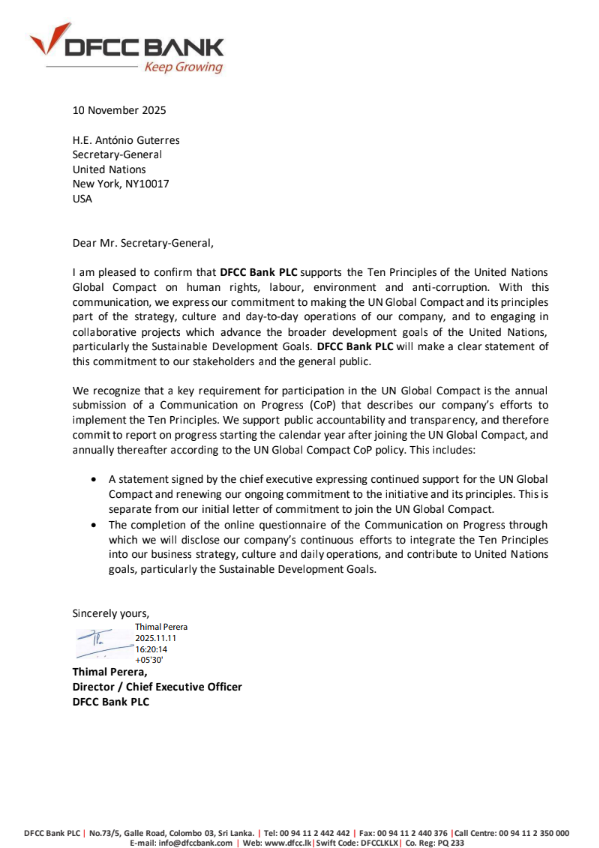
Commitment letter by the CEO of DFCC Bank addressed to the Secretary General of United Nations to abide by the Ten Principles of UNGC.