I am pleased to present the Bank’s Corporate Governance report on behalf of our Board. The report
includes details of how governance underpins our business, and the decision-making as we deliver our
strategy and create long-term value for our shareholders.
The Bank recognises corporate governance as a dynamic concept, supported by a framework of rules,
systems, and processes adopted by the organisation. Good governance facilitates effective management and
enables the Bank to maintain a high level of business ethics. The Board sets the example for employees
of the Bank by implementing the highest standards of business ethics and corporate governance. We
maintain a zero-tolerance approach to bribery and corruption, and expect all employees to comply with
applicable laws, regulations, and internal standards. Any breaches are addressed firmly and
consistently, regardless of seniority, under the Bank’s disciplinary policy.
The high standards of corporate governance continue to be a key priority for the Board. Corporate
governance practices of the Bank are in accordance with the Board-approved Corporate Governance Charter,
Central Bank of Sri Lanka (CBSL) Directions on Corporate Governance, and the Listing Rules of the
Colombo Stock Exchange (CSE) on Corporate Governance. The Bank’s existing corporate governance framework
mandates the responsibilities and duties of the Board and the Management to the shareholders and other
stakeholders towards the promotion of a strong corporate governance culture. The Bank’s corporate
governance framework is well-structured and supported by a strong focus on integrity, accountability,
transparency in the manner of doing business, and clear and timely communication.
Our commitment to strong corporate governance and ethical conduct remains unwavering.
We continually review the framework within which we operate and the processes implemented to ensure
that they reflect the complexities of our business and meet the needs of our stakeholders. The Board
understands the benefits of annual performance evaluations, both for Directors on an individual basis as
well as for the Board as a whole, and looks for ways in which it can improve and develop.
We firmly believe that Board independence is essential to bring objectivity and transparency in the
Management and in the dealings of the Bank. As at the end of the year, the majority of our Board members
– six out of eight – are independent members. An Independent Director functions as the Chairperson of
the Audit, Nomination and Governance, Integrated Risk Management, Human Resources and Remuneration, and
Related Party Transactions Review Committees.
This year too, the Bank achieved a groundbreaking milestone with the issuance of Sri Lanka’s first-ever
Blue Bond, which is listed on the CSE. The listing of Sri Lanka’s first Blue Bond is a significant
milestone for the Bank and for the country. It brought much-needed focus to the development of
sustainable finance and the role it can play in shaping Sri Lanka’s future. We are honoured to have
initiated this effort and confident that it will mark the beginning of a long and meaningful journey in
supporting coastal resilience, clean water, marine restoration, and other essential areas of national
importance.
Building on the successful issuance and dual listing [on the CSE and the Luxembourg Stock Exchange
(LuxSE)] of Sri Lanka’s first ever Green Bond in 2024, we took another bold step by listing the said
bond on the prestigious International Exchanges in GIFT City, India, namely the National Stock Exchange
– International Exchange (NSEIX), and the India International Exchange (IFSC) Limited (India INX). This
multiple listing underscores our commitment to global sustainability standards and expanding access to
international capital markets.
As we look towards the future, community engagement holds a special place in our hearts. We are
committed to expanding our initiatives and social responsibility programmes over the coming year,
contributing positively to the communities we serve.
I confirm to the best of my knowledge that there were no material violations of any of the provisions
of the directions of CBSL, other applicable laws and regulations, codes of conduct, and other related
policies and procedures of the Bank.
J Durairatnam
Chairman
24 February 2026
GRI
2-9
MANDATE OF THE BOARD
The Board is responsible for the Bank’s system of corporate governance, and is committed to maintaining
high standards and developing governance arrangements to comply with best practices. Ultimate
responsibility for the management of the Bank rests with the Board of Directors. The Board focuses
primarily upon strategic and policy issues and is responsible for the Bank’s long-term success. It sets
the Bank’s strategy, oversees the allocation of resources, and monitors the performance of the Bank. It
is also responsible for effective risk assessment and management. The Board has a formal schedule of
matters reserved to it and delegates certain responsibilities to its committees. The Board meetings are
held ordinarily on twelve scheduled occasions during any given year, as well as holding ad hoc meetings
to consider non-routine business, if required.
The interactions in the governance process are shown in the schematic below:
THE BOARD
Responsible for strategy, risk management, succession planning, and policy issues. Sets the tone,
values, and culture of the Bank. Monitors the Bank's progress against the set targets.
CHIEF EXECUTIVE OFFICER
Develops strategy for approval by the Board. Directs, monitors, and maintains the operational
performance of the Bank. Responsible for the application of policies and implementation of
strategy. Accountable for the Bank's performance.
NON-EXECUTIVE DIRECTORS
Exercise a strong independent voice, challenging and supporting the Executive Director.
Scrutinise performance against objectives and monitor financial reporting. Monitor and oversee
risks and controls, determine the Executive Director and Key Management Personnel (KMP)
remuneration, and manage the Board and KMP succession through their committee responsibilities.
CHAIRMAN
Provides leadership and guidance to the Board, promoting high standards of corporate governance.
He is the link between the Executive and Non-Executive Directors.
COMPANY SECRETARY
Advises the Chairman on Governance, together with updates on regulatory and compliance matters.
Supports the Board agenda with clear information flow. Acts as the link between the Board and its
Committees, and between Non-Executive Directors and the Senior Management.
GRI
2-23
2-24
GOVERNANCE FRAMEWORK OF THE BANK
REGULATORY AND INTERNAL POLICY FRAMEWORK
The main elements which encompass the governance framework of the Bank are outlined below:
Directions issued to licensed commercial banks by the Central Bank of
Sri Lanka
Banking Direction No. 05 of 2024 on Corporate Governance issued by the
Central
Bank of Sri Lanka
Companies Act No. 07 of 2007 and amendments thereto
Banking Act No. 30 of 1988 and amendments thereto
Code of Best Practice on Corporate Governance issued by CA Sri Lanka
Internal Elements
Articles of Association of the Bank
Governance Charter
Policy on Related Party Transactions
Code of Conduct of Directors
Employee Code of Conduct
Statement of Policy on Prohibiting Insider Dealings
Policy on Ascertaining Fitness and Propriety
Whistle-blowing Policy
Disclosure Policy
Anti-Bribery and Corruption Policy
Compliance Policy
Financial Consumer Protection Policy
Environmental, Social, and Governance Policy
Investor Relations and Shareholder Communication Policy
Risk Policies
Anti-Money Laundering Policy
Remuneration Policy
Accessibility Policy
Asset Management Policy
Other policies governing operational areas
Directions, Circulars issued by the Securities and Exchange
Commission of
Sri Lanka (SEC)
Acts, Circulars, Gazettes issued by Tax Authorities
Listing Rules of the Colombo Stock Exchange (CSE)
Shop and Office Employees Act No. 19 of 1954 and amendments
thereto
The list of Policies governing Corporate Governance practices of the Bank can be accessed via the link
https://www.dfcc.lk/about-us/governance/company-policies. These policies are reviewed
periodically and changes are introduced as and when required.
The Bank is in full compliance with the requirements of the Policy described in Section 9.5.1 of the
CSE Listing Rules governing matters relating to the Board of Directors.
The Chairman has assigned the CEO to maintain a dialogue with institutional investors and bring any
matters of concern raised by shareholders to the notice of the Board.
Good corporate governance is a mechanism that harmonises the interests of a wide range of stakeholders
of an institution, while contributing to sustainable growth by attracting outside sources of capital.
The Bank practices high standards of corporate governance based on the Organisation for Economic
Co-operation and Development (OECD) principles of good governance.
GRI
2-9
OECD principles of good governance are based on the following six guidelines:
Promoting transparency, being consistent with laws, and clearly articulating division of
responsibilities.
Protecting and facilitating the exercise of shareholder rights, ensuring equitable treatment of all
shareholders and recognising the rights of stakeholders in creating wealth.
Exercising due diligence and responsibility in capital market operations.
Timely and accurate disclosure on all material matters regarding the Bank, including financial
situation, performance, ownership, and governance.
Sustainability and resilience.
By way of an effective Governance Framework, ensuring the strategic guidance of the Bank, effective
monitoring of management of the Board, and the Board’s accountability to the Bank and its
shareholders.
The key corporate governance practices of the Bank are given in this report with specific disclosures
relating to the status of compliance with the mandatory requirements of Direction No. 05 of 2024 of the
CBSL. In addition to the requirements of the CBSL Direction, the corporate governance rules applicable
to listed entities given in Section 9 of the Listing Rules of CSE are also applicable to the Bank. The
Bank is in full compliance with the said CSE Rules on Corporate Governance.
CORPORATE GOVERNANCE STRUCTURE
GRI
2-18
2-19
2-20
GOVERNANCE RELATING TO BOARD REMUNERATION
The Bank follows a structured and transparent process for designing and determining remuneration for
Board and KMPs. Oversight of all remuneration-related matters is entrusted to the Human Resources and
Remuneration Committee and the Committee ensures independence, objectivity, and alignment with best
practices when recommending remuneration structures, contractual terms, and performance-linked pay for
CEO and KMPs. Recommendations made by the Committee are submitted to the Board for approval.
REMUNERATION POLICIES AND PROCEDURES FOR THE BOARD
Remuneration for the Board is governed by a transparent framework designed to uphold accountability,
independence, and regulatory compliance. The shareholders are called upon to pass a resolution at each
Annual General Meeting to authorise the Board of Directors to determine their remuneration. In
determining remuneration, the Board considers benchmarking data from comparable private sector financial
institutions to ensure that the Director fees remain reasonable, appropriate, and competitive.
Non-Executive Directors are remunerated through a fixed monthly retainer and meeting attendance fees,
reflecting their statutory and fiduciary responsibilities. Additionally, fees are paid for participation
in Board Committee meetings, recognising the added oversight responsibilities performed by the members.
Non-Executive Directors are not entitled to any additional benefits for serving on the Board. The
Directors are not eligible to participate in employee share ownership or option schemes, ensuring
independence and avoidance of conflicts of interest.
In line with directions issued by the Central Bank of Sri Lanka (CBSL), the Directors do not receive
retirement benefits, and the introduction of any such benefit would require prior shareholder approval.
This reflects the Bank’s strong adherence to regulatory expectations and governance best practices.
EVALUATION OF BOARD PERFORMANCE
The Board carries out an annual evaluation of the performance, effectiveness, and governance practices
of the Board in accordance with the requirements of the CBSL. The assessment evaluates the collective
performance of the Board against an established set of criteria that reflect regulatory requirements and
best practices. The effectiveness of Board meetings, compliance and regulatory assurance, Committee
reporting, the Board’s adherence to sound governance principles, Board composition, appointments and
succession are covered in the evaluation.
In addition, the Nomination and Governance Committee carries out an annual evaluation of the Board
covering the performance of the Board and how well the Board has carried out its duties during the year,
the evaluation of the Chairman’s role, and the Board’s relationship with the CEO. The assessment also
focuses on the Chairman’s ability to provide leadership to the Board and foster an environment of open
and constructive dialogue, ensure effective participation of all Directors and uphold governance and
ethical standards, manage Board processes, meeting conduct, and information flows efficiently. The CEO’s
annual performance evaluation is carried out by the Board, based on Board-approved goals and
predetermined KPIs. The Human Resource and Remuneration Committee submit recommendations to the Board
regarding performance-linked remuneration and the CEO’s goals for the year.
BOARD CULTURE
The Board of Directors are encouraged to be open and forthright in their approach, with active debate
encouraged during Board meetings before any decisions are taken. We believe this helps to forge strong
and open working relationships, while enabling our Directors to engage fully with the Bank and allowing
them to make their best possible contribution.
BOARD REFRESHMENT
Periodically, the Board welcomes fresh talent due to retirement, resignation, or any other exigency
that prompts the exit of a current Director. Such new appointments infuse new talent and fresh ways of
thinking, which are required for a business that is sustainable.
GRI
2-23
2-24
2-25
2-26
BOARD MEMBERS ACCESS TO INFORMATION
The Directors receive the Board Circulars well ahead the date of the Board Meeting. In addition, they
may request further information or expert advice as they deem necessary to make clear and informed
decisions. On appointment, Directors are provided with an orientation covering the key areas of the
Bank.
CONDUCT AND ETHICAL FRAMEWORK
The Bank’s framework for ethical conduct based on transparency and integrity with strict adherence to
laid down policies and procedures is non-negotiable. This area is governed by several key policies and
procedures.
The Board
The Employees
The Code of Conduct for Directors adopted by the Bank, which the Directors are expected to
abide by, encompasses the following:
Compliance with laws, rules, and regulations
Avoidance of conflicts of interest
Maintenance of confidentiality of information
Fair dealing with stakeholders
Protection of the Bank’s assets
Employee behaviour is governed by a separate Code of Conduct including other policies and
procedures such as the Anti-Bribery and Corruption Policy, Disciplinary Code, Statement of Policy
on Prohibiting Insider Trading, Whistle-blowing Policy, Anti-Money Laundering Policy, Compliance
Policy, Disclosure Policy, etc.
WHISTLE-BLOWING POLICY
This is a vital mechanism for employees to report misconduct, fraud, or unethical practices within the
Bank. The policy establishes a confidential tool for employees to escalate concerns that can potentially
harm the Bank’s reputation or jeopardise the health and safety of employees, without fear of reprisal.
The Bank assures the whistle-blower's confidentiality and pledges to shield them from reprisals.
An investigation will be carried out on any matters brought to notice and, if required, steps will be
taken to rectify the issue.
ANTI-BRIBERY AND CORRUPTION POLICY
The Bank opposes all forms of bribery and corruption. The Anti-Bribery and Corruption Policy governs
the Bank’s Anti-Bribery and Corruption Framework, overseen by the Fraud Risk Management Committee
(FRMC). This process ensures the Bank’s strict compliance with local laws that safeguard its reputation
and standing with the regulators.
The ethos of the policy is applicable to all, including directors, employees, and authorised
representatives, prohibiting engagements with individuals or entities associated with or vulnerable to
bribery and corruption. FRMC conducts routine policy assessments, using audits, compliance checks, and
Human Resource (HR) assessments to ensure alignment with the Bank’s steadfast stance of zero tolerance
towards bribery and corruption. The Employee Code of Conduct also outlines employee conduct guidelines,
including bribery and corruption regulations.
GIFTS AND INDUCEMENTS
Accepting gifts and inducements can compromise objectivity, leading to biased decision-making or
preferential treatment. It undermines trust, potentially damaging the Bank’s reputation and credibility,
and violates ethical standards. Declining gifts and inducements ensures ethical conduct, preserves
professionalism, and upholds the Bank’s integrity, fostering a culture of transparency, fairness, and
trustworthiness.
In terms of the Employee Code of Conduct, employees are prohibited from seeking or receiving gifts and
incentives from customers and other third parties involved in the Bank’s business, except for nominal
token gifts associated with celebratory occasions.
ANTI-MONEY LAUNDERING POLICY
In the current digitised financial landscape where high-value transactions move across accounts and
financial markets, money laundering is an ever-present threat. The Bank’s Anti-Money Laundering Policy
stringently applies the regulatory requirements to ensure it is not used by unscrupulous individuals to
launder money or to utilise funds for illegal purposes.
Staff training is conducted to ensure this is fully ingrained for compliance, and a separate department
is responsible for ensuring the Bank’s policy and procedure stay current with local and global
standards.
GRI
2-9
2-12
2-13
2-14
SUSTAINABILITY, and ENVIRONMENTAL, SOCIAL, AND GOVERNANCE (ESG)
The Board provides strategic oversight to ensure sustainability and ESG considerations are embedded
into the Bank’s business model, operations, short- and medium-term planning, and long-term strategy.
This approach strengthens resilience and supports durable value creation for shareholders and
stakeholders.
Accordingly, sustainability and climate-related matters are built into the Board and Board Integrated
Risk Management Committee agendas, and are evaluated alongside the Bank’s risk appetite, so ESG
oversight is embedded within core governance and risk decision-making rather than treated as a
standalone agenda item.
The Board’s ESG oversight covers:
Strategic Alignment – Integrating sustainability into DFCC Bank's corporate
strategy and capital allocation.
Risk Management – Identifying and mitigating sustainability and climate-related
risks through scenario analysis and stress testing.
Regulatory Compliance – Preparing for SLFRS S1 and S2 disclosures, mandatory
adoption effective from 2025 (transition relief has been obtained where available).
Stakeholder Engagement – Maintaining dialogue with regulators, investors,
customers, employees, and communities to align ESG priorities with stakeholder expectations.
Innovation for Sustainable Finance – Driving green finance (both lending and
fundraising), renewable energy lending, and inclusive banking solutions.
The Bank integrates ESG risks and opportunities into strategic and business plans presenting the Board
with short-medium-and long-term ESG targets linked to DFCC Bank's Sustainability roadmap.
THE GOVERNANCE FRAMEWORK FOR SUSTAINABILITY AND ESG
To strengthen ESG integration across its operations, the Bank has established a multi-tier governance
structure. At Board level, the Board Integrated Risk Management Committee (BIRMC) provides dedicated
oversight on sustainability-related risks and opportunities, ensuring ESG considerations are embedded
into the Bank’s risk governance framework and strategic decision-making. BIRMC, comprising three Board
representatives along with the CEO and the Deputy Chief Executive Officer (DCEO), is supported by Key
Management Personnel including the Chief Risk Officer, Chief Compliance Officer, Head of Treasury, and
Head of Sustainability as permanent invitees. This structure also aligns with SLFRS S1, which requires
clear governance for sustainability disclosures. The Executive Sustainability Management Committee
(ESMC) chaired by the CEO is the executive level management committee that provides management level
oversight on sustainability governance. Complementing this, the Sustainability Management Committee
(SMC) operates as a second-tier management committee under ESMC. Chaired by the DCEO, SMC acts as a
working group to monitor ESG performance, review progress against targets, and drive strategic
priorities through cross-functional collaboration with representatives from key departments and business
units. Together, these committees ensure that ESG principles are integrated into DFCC Bank's
strategy, operations, and reporting, reinforcing the Bank’s commitment to responsible and sustainable
banking.
Terms of Reference of ESMC and BIRMC were updated during the year to reinforce sustainability-related
financial disclosures and clarify roles for successful ESG implementation. Importantly, every employee
plays a vital role in contributing to the Bank’s sustainability strategy, ensuring that sustainability
is embedded across all levels of the organisation. Through this collective effort and strong governance,
the Bank continues to drive resilience, innovation, and long-term stakeholder value.
ENHANCING ESG CREDENTIALS THROUGH ESMS IMPLEMENTATION
The Board remains firmly committed to strengthening the Bank’s ESG credentials as a strategic priority.
To this end, the Bank has implemented a robust Environmental and Social Management System (ESMS) since
2016 to identify, assess, and mitigate environmental and social risks within credit operations, thereby
reducing its environmental footprint and enhancing social impact. Governance has been reinforced through
the Management Credit Committee and the appointment of a dedicated ESMS Officer to oversee the
integration of environmental and social risk considerations across all operations. Complementing this,
the Bank has formalised its approach through the ESG Policy, while fostering employee engagement via
regular training programmes. Capacity-building initiatives on environmental and social due diligence are
conducted regularly by the Sustainability Department in collaboration with the Learning Academy,
ensuring staff are equipped to uphold the Bank’s sustainability objectives.
GRI
2-17
BOARD CAPACITY BUILDING ON SUSTAINABILITY AND ESG
The Bank recognises that effective oversight of sustainability matters requires a well-informed and
capable Board. To strengthen governance capability, the Bank invests in continuous training and
knowledge enhancement for Board members and senior management on critical sustainability topics,
including ESG principles, climate-related risks, SLFRS S1 and S2 disclosure requirements, and global
sustainability trends.
During the year, the Board actively participated in ESG and sustainability-related training, awareness
programmes, and knowledge-sharing sessions organised by the Bank and leading external experts. These
initiatives ensure that the Board collectively builds expertise, remains informed of emerging ESG
developments, and reinforces its role in guiding DFCC Bank's sustainability strategy.
Programme description
Attendance
Sustainability reporting and the Implementation of SLFRS S1 and S2:The session
included: Evolution of ESG/sustainability, an introduction to slfrs sustainability disclosure
standards, adoption of SLFRS sustainability disclosure standards, governance-related disclosure
requirements.
09
Awareness session on Cybersecurity:The session included: Understanding
Information security and privacy, current threat landscape in the finance sector, case studies of
security breaches, strategies for enhancing security and privacy, role of the Board in Information
security governance.
09
McKinsey Turbo charging growth through AI: The programme included an overview
of Artificial Intelligence (AI) and its impact in financial services.
09
Awareness session on Companies (Amendment) Act No. 12 of 2025, Amendments to the CSE Listing
Rules and Directors Relevant Interest.
09
Workshop on “Can Banks De-Risk and Innovate in this Hyper-Competitive Age with Technology.”
02
Workshop on Board’s Role in Mandatory Sustainability Reporting.
02
Improving the Governance Framework: Ensuring greater accountability of the
Board of Directors for the compliance obligations of Anti-Money Laundering, Countering the
Financing of Terrorism, and Proliferation Financing.
02
In addition, the Bank circulated an awareness questionnaire on SLFRS S1 and S2 and a training needs
assessment focused on sustainability-related financial disclosures for the Board ensuring strong
engagement in preparing for the upcoming regulatory requirements.
INTEGRATED REPORTING
The Bank places a strong emphasis on integrated reporting, combining financial and non-financial
information to provide a transparent and holistic view of the Bank’s performance. This approach enhances
accountability and meets the growing expectations of stakeholders for responsible and ethical business
practices.
The Board has taken deliberate steps to evaluate ESG risks and opportunities and embed these
considerations into the Bank’s operations and strategic planning. By integrating sustainability into
decision-making, DFCC Bank fosters resilience, supports long-term growth, and strengthens its ability to
manage emerging risks effectively.
To ensure informed decision-making, the Board is updated on sustainability performance on a quarterly
basis through the BIRMC and may, from time to time, request comprehensive analysis reports from internal
teams and external experts to maintain adequate due diligence. Additionally, the Board reviews ESG
factors as necessary to strengthen and enhance ESG-related areas within the Bank’s operations.
Upholding the highest standards of corporate governance, the Board ensures that our actions contribute
to long-term value creation, robust risk mitigation, and sustainable development. This comprehensive
approach underscores the Bank’s unwavering commitment to responsible banking and sustainability
leadership.
Further details on the Bank’s sustainability framework and initiatives are presented in the following
sections of this Annual Report:
The Board is also responsible for ensuring that management maintains a system of internal control that
provides assurance of effective and efficient operations, internal financial controls, and compliance
with laws and regulations. In carrying out this responsibility, the Board gives due consideration to
what is appropriate for the Bank’s business and reputation, the materiality of financial, and the
relative costs and benefits of implementing specific controls. The Board is also the decision-making
body for all other matters of importance to the Bank as a whole due to their strategic, financial, or
reputational implications or consequences. There is a formal schedule of matters reserved for the
Board’s decision. Our risk management process identifies the key risks facing each business and reports
to the Board on how those risks are being managed. Such a system of internal control can only be
designed to manage, rather than eliminate, risk of failure, to achieve business objectives, and can
provide reasonable but not absolute assurance against material misstatement and loss. The Board has a
process for identifying, evaluating, and managing the risks we face. That process is continual and has
been in place for the year under review up to and including the date of this report.
Further aspects that impact the internal control framework of the Bank are covered under Integrated
Risk Management on pages 239 to 267.
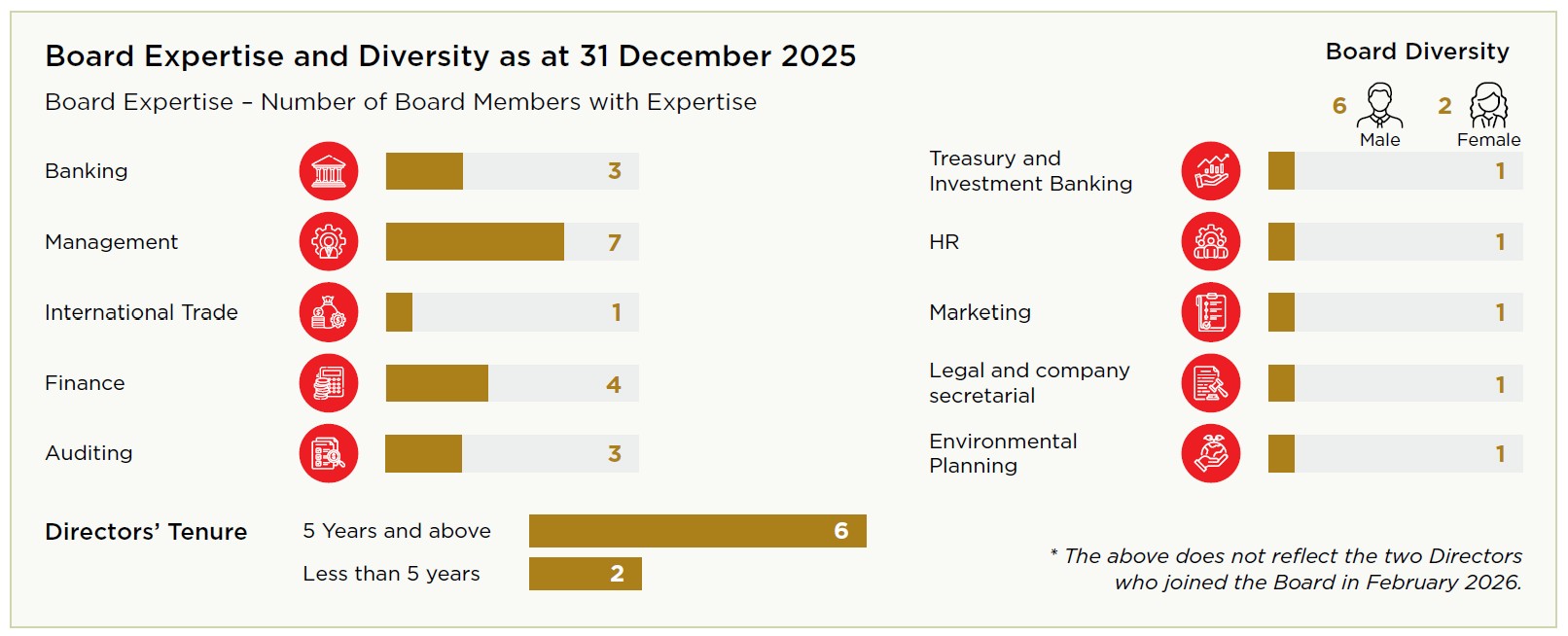
Board Expertise and Diversity
The Board brings together a well-balanced blend of professional expertise, industry knowledge, and
diverse perspectives essential for guiding the Bank’s strategic direction and governance
responsibilities. This spectrum of competencies ensures that the Board is equipped to provide robust
oversight, informed decisions, and effective stewardship in driving the Bank’s long-term value creation
and sustainable growth.
BOARD OF DIRECTORS
The Directors of the Bank as at 31 December 2025 categorised in accordance with the criteria specified
in the Banking Act Direction No. 05 of 2024 issued by the CBSL are as follows:
Independent Non-Executive Directors
J Durairatnam – Chairman
Ms L K A H Fernando
N K G K Nemmawatta
Ms A L Thambiayah
N Vasantha Kumar
H A J de S Wijeyeratne
Non-Independent Non-Executive Director
P A Jayatunga
Executive Director
N H T I Perera – Chief Executive Officer
The Independent Directors satisfy the criteria set out in section 9.8.3 of the CSE Listing Rules.
Further, all Directors satisfy the fit and proper assessment criteria stipulated in the CSE Listing
Rules.
None of the above Directors (including close family members) has had any relationship with the other
Directors.
GRI
2-12
2-23
2-24
BOARD HIGHLIGHTS 2025
Approved the Strategic Plan for 2025-2029
Revised the limits on delegation of authority on lending and related activities
Revised the limits on delegation of authority for capital and revenue expenditure
Decided to carry out a brand health/equity study for the Bank
Approved the payment of a dividend of LKR 6 per share (scrip and cash) for 2024
Approved the Accessibility Policy
Approved the Policy on Financial Consumer Protection
Approved the appointment of two new Directors to the Board subject to the approval of CBSL
Approved the listing of DFCC Bank's Green Bond on the National Stock Exchange International
Exchange (NSEIX) India and on the India International Exchange (IFSC) Limited (India INX)
Approved the establishment of a fully owned subsidiary to focus on value added financial services
including wealth management, underwriting, and corporate financial advisory to clients
Approved the implementation of a Programme for Service Excellence
Approved the Sustainable Bond Framework
Conducted awareness sessions for Directors on:
– Cybersecurity and Amendments to the Companies Act
– The Board’s Role in Sustainability Reporting and the Implementation of SLFRS S1 and S2
Decided to issue up to 100,000,000 Basel III Compliant, Subordinated, Listed, Rated, Unsecured,
Redeemable GSS+ Bonds
Decided to issue up to 30,000,000 Senior, Listed, Rated, Unsecured, Redeemable Blue Bonds
Approved the Corporate Social Responsibility (CSR) Project on Leopard Conservation
Decided to enter into an agreement with Standard Chartered Bank for the acquisition of their wealth
and retail banking business in Sri Lanka
Revised the Terms of Reference of Board Committees
Reviewed all major policies
Reviewed and endorsed the Key Performance Indicators (KPIs) of Key Management Personnel
PERMANENT BOARD COMMITTEES AS AT 31 DECEMBER 2025
*The Credit Restructure Committee approves papers by circulation
Attendance of Directors at meetings – 2025
Name of Director
Main
Board
Audit
Committee
Human
Resources and
Remuneration
Committee
Nomination and
Governance
Committee
Integrated
Risk
Management
Committee
Credit
Approval
Committee
Related Party
Transactions
Review
Committee
Total number of meetings
14
10
2
7
6
12
12
J Durairatnam
14/14
1/1
2/2
7/7
12/12
12/12
Ms L K A H Fernando
14/14
10/10
W R H Fernando
13/14
8/9
7/7
6/6
P A Jayatunga
14/14
2/2
6/6
N K G K Nemmawatta
14/14
12/12
12/12
N H T I Perera
14/14
Ms A L Thambiayah
11/14
2/2
11/12
11/12
N Vasantha Kumar
13/14
7/7
6/6
H A J de S Wijeyeratne
14/14
10/10
Attended/eligible to attend
SHAREHOLDER RIGHTS
The basic rights of shareholders include;
The ability to transfer shares freely
To have access to financial and other relevant information about the entity on a regular and timely
basis
The ability to effectively participate in shareholder meetings
Appoint Directors and Auditors
Equitable treatment relating to the type of shares owned.
The shares of the Bank are freely transferable through the Colombo Stock Exchange (CSE) but subject to
limitations stated in the Articles of Association of the Bank and the Banking Act.
The Board approved Investor Relations and Shareholder Communication Policy ensures that information
relating to the financial performance and progress of the Bank is made available to shareholders through
timely disclosures made to the CSE.
During the year, shareholders were notified, through announcements made to CSE, of quarterly results,
dividend declaration for 2024, Annual Financial Statements for 2024, Interim Financial Statements for
2025, date of the Annual General Meeting in 2025, date of the Extraordinary General Meeting in 2025,
GSS+ Bond Issue, Blue Bond Issue, etc. The Bank’s website has a dedicated area “Investor” for investors,
which includes Interim Financial Statements, Annual Reports, and Debt Instruments.
The Annual Report contains a comprehensive review of performance as well as other information of
relevance to the other stakeholders apart from reporting on the financial condition of the Bank and the
Group. All important information is given publicity through the print and electronic media and posted on
the Bank’s website.
The Bank has procedures to promptly disseminate price-sensitive information and trading in shares by
the Directors to the CSE, as required by the Listing Rules. In instances where this is not possible, the
Chief Financial Officer advises closed periods for trading in the Bank’s shares by employees and
Directors. The Board has formally adopted a Statement of Policy Prohibiting Insider Trading. As a
general rule, the period after the end of each quarter up until two market days after the financial
information is released is treated as closed periods. Procedures are in place to detect any violations.
During the year under review, the Bank shared a reasonable portion of its profit for 2024 with
shareholders in the form of cash dividend, while retaining the balance funds to support its growth and
development. This year, the Bank also distributed part of the dividend as a scrip dividend.
All shareholders of the Bank are treated equally on the basis of one vote per ordinary share. The Bank
has not issued any non-voting ordinary shares or preference shares.
SHAREHOLDER MEETINGS
The Annual General Meeting (AGM) of the Bank is normally held within a period of one year from the date
of the previous meeting, after giving adequate notice to shareholders as required by the Articles of
Association. Accordingly, the AGM was held on 28 March 2025.
The Annual Report and Notice of Meeting are sent to all shareholders in order to enable effective
shareholder participation at the meeting. The shareholders have the opportunity to access the Annual
Report via a web link or obtain a printed document.
Extraordinary General Meetings (EGM) are held to obtain shareholder approval on matters that require
such approval. An EGM was held on 30 October 2025 to obtain the approval of shareholders for the GSS+
Bond issue.
Annual Corporate Governance Report for the year Ended 31 December 2025 Published in Terms of Section
1.11 of the Banking Act Direction No. 05 of 2024
Section
Governance principle
Compliance
Remarks
1.
Ultimate Responsibility and Accountability of the Board
Compliant
The Board is ultimately responsible and accountable for overseeing the Bank’s affairs,
governance framework, business strategy, financial soundness, and risk management, and for
ensuring compliance with all applicable laws, regulations, and sound banking practices.
Directors make objective decisions in the best interests of all stakeholders. Board decisions
are taken collectively and duly recorded, with any dissent by a Director expressly noted in the
minutes.
1.1
Responsibilities of the Board
Compliant
The Board has strengthened the safety and soundness of the Bank through the implementation of
(a) to (w) as given below.
(a) Strategic objectives and corporate values
Compliant
The Bank sets its strategic objectives and goals for the long-term through the functional
strategic plan which is approved by the Board. These goals and the corporate values approved by
the Board are communicated to the business units and other staff. The corporate values are
posted on the Bank’s intranet and all employees are guided by these values.
(b) Overall business strategy
Compliant
The Bank’s Strategic Plan was approved by the Board in January 2025. It was formulated
covering the period 2025-2029, with a higher level of emphasis on the period 2025-2027, with
indicative objectives for the remaining period.
The Board engages in the strategic planning and control of the Bank by overseeing the
formulation of business objectives and targets, assessing risks by engaging qualified and
experienced personnel, delegating them with the authority for conducting operational activities
and monitoring performance through a formal reporting process.
A separate item has been included in the agenda at every Board meeting under the heading
“Strategic Discussion” to take up any matter of strategic importance to the Bank. Directors are
encouraged to identify and communicate any matter they consider to be of strategic importance.
Periodic updates or revisions of the Strategic Plan are considered and formulated as and when
needed.
(c) (i) Identify principal risks and ensuring implementation of appropriate systems to
manage risk.
Compliant
Integrated Risk Management Framework was reviewed during the year.
The Board Integrated Risk Management Committee (BIRMC) appointed by the Board has Bank-wide risk
management oversight and assists the Board in fulfilling its statutory responsibilities. The
BIRMC's primary function is to assist the Board in fulfilling its risk management
responsibilities as required by business needs, internal policy guidelines, and applicable laws
and regulations.
(c) (ii) Establish well-defined organisational responsibilities for the three lines of
defence
Compliant
In the governance structure, management control at the business level and relevant internal
control mechanisms act as the first line of defence, where they are responsible for the
strategy, performance, and risk management of the Bank.
The Bank has centralised oversight of effective implementation of risk management framework as
the second line of defence, which is responsible for the policy implementation, monitoring, and
oversight. This is mainly done by Integrated Risk Management Department and Compliance
Department.
The Internal Audit function acts as the third line of defence, which provides the organisation
with independent and objective assurance on the risk exposures, processes, and practices in
place.
(c) (iii) Ensure that the risk management, compliance, and internal audit functions are
positioned and resourced to carry out the responsibilities
Compliant
The Board ensures that the Risk Management, Compliance, and Internal Audit functions are
appropriately structured, sufficiently staffed, and adequately resourced to operate
independently and effectively. The Board approves their mandates, reviews their performance on a
regular basis, and provides the necessary authority and resources to discharge their
responsibilities in line with regulatory requirements and best practices.
(c) (iv) Define the risk appetite of the Bank aligning with strategic, capital, and financial
plans
Compliant
The Bank has an internally developed Risk Appetite Statement, which was approved by the Board
and it is reviewed periodically. The Risk Appetite Statement is aligned with the Bank’s
strategic objectives, capital planning, and financial plans.
(c) (v) Outline the actions to be taken when stated risk appetite limits are breached.
Compliant
The Bank continuously monitors the risk limits based on the Risk Appetite Statement and
actions are taken when risk limits are near breach or breached. Overall Risk Limits are
periodically submitted to the relevant Management Committee, BIRMC, and the Board highlighting
near breaches and breaches.
(d) Avoidance of Board dominance
Compliant
The Board-approved Policy on Directors Code of Conduct ensures that the Board is not
dominated or significantly influenced by a Director or a group of Directors in a manner
detrimental to the interest of the Bank as a whole.
(e) Communication with stakeholders
Compliant
The Board-approved Investor Relations and Shareholder Communication Policy ensures that
information is made available to shareholders and other stakeholders through timely disclosures
made to the Colombo Stock Exchange (CSE), and by publicity through the press and electronic
media and posts on the Bank’s website.
The Bank has an internally developed Code of Conduct for its employees, which is posted on the
Bank’s intranet and is accessible by all employees. The Bank has also adopted a separate Code of
Conduct for the Directors.
(f) Bank’s internal control and management information systems
Compliant
The Audit Committee assists the Board in reviewing and evaluating the integrity, adequacy,
and effectiveness of the internal control system, including management information systems and
controls over the financial reporting of the Bank.
The Internal Audit carried out quarterly reviews to ensure that the internal control systems are
functioning as appropriate.
The report by the Board of Directors on Internal Control over Financial Reporting is given on
page 288. The Independent Assurance Report by the External Auditor on the Directors’ Statement
on Internal Control is given on page 291.
(g) Managing related party exposures
Compliant
The Related Party Transaction Review Policy is in place to ensure that related party
transactions are managed in such a way to avoid conflict of interest. Further, the related party
transactions are reviewed by the Related Party Transactions Review Committee.
(h) Business continuity and disaster recovery plans
Compliant
The Bank has a comprehensive Business Continuity Plan (BCP) and a Disaster Recovery (DR)
covering all critical functions and systems to ensure financial stability, operational
resilience, and preserve critical operations during any disruptive event. The Bank has obtained
ISO 22301 certification for Business Continuity Management Systems (BCMS).
(i) Oversee the approach to remuneration
Compliant
The Board oversees the Bank’s approach to remuneration through the Human Resources and
Remuneration Committee, which reviews and recommends all increments and changes to the
remuneration of the CEO and Key Management Personnel (KMP) for Board approval.
The Committee also reviews and recommends changes to benefit schemes, ensuring that remuneration
practices are aligned with the Bank’s risk culture, risk appetite, and long-term strategic
objectives.
(j) Key Management Personnel (KMP)
Compliant
The Board has identified and designated its Key Management Personnel.
(k) Authority and responsibility of the CEO and KMP
Compliant
Areas of authority and key responsibilities of Directors have been set out in the Corporate
Governance Charter which has been adopted by the Board. The Board has also identified matters
specifically reserved for the Board. The duties and responsibilities of other KMP are formally
documented in their job descriptions. Delegation of authority levels for KMP has also been
clearly specified in Board-approved circulars.
(l) Oversight of the affairs of the Bank by the CEO and KMP
Compliant
Oversight is exercised through Board Committees, reporting to the Board as appropriate.
Policies and decisions of the Board requiring appropriate follow up are communicated by the
Board Secretary to the relevant KMP.
Minutes of relevant management committee meetings headed by the Chief Executive Officer (CEO)
are submitted to the Board for information. KMP are called upon to clarify matters and make
presentations on matters within their purview at the monthly Board meetings.
(m) Board’s own governance practices
Compliant
An annual self-assessment is carried out on a structured format where the Directors submit
their individual responses directly to the Board Secretary. The responses are collated by the
Board Secretary and submitted to the Board. The effectiveness of the Board’s own governance
practices is reviewed by the Board and areas for improvement are discussed for necessary action.
During this year too, in addition to the assessments carried out by the individual members, the
Nomination and Governance Committee, based on a separate checklist, carried out an evaluation of
the Board and the results were shared with the other members of the Board and an opportunity was
provided to them to comment on the findings of the Committee.
(n) Self-assessment of the Board of Directors
Compliant
The Board has a structured scheme of self-assessment which is carried out annually. The
performance of the respective committees is also evaluated by the other members who are not
members of the respective committees, in order to ensure that they function effectively. The
findings are discussed at the Board meetings and action is taken on areas identified for
improvement.
The performance assessment criteria of the CEO is given in 5.4 a).
(o) Succession plan for the CEO and the KMP
Compliant
The Bank has in place a succession plan for the CEO and the KMP, which is reviewed annually
by the Nomination and Governance Committee and approved by the Board.
(p) Regular meetings with CEO and KMP to monitor progress
Compliant
Meetings are attended by relevant executives when required. Additional information sought by
Directors on papers submitted to the Board is clarified by the respective officers. The Board
has free access to Senior Management.
During the year, the Board reviewed the performance in order to monitor progress against the
budget. This provided an opportunity for the Board members to interact with the Senior
Management to clarify reasons for variations against budget and to suggest corrective action.
(q) Regulatory environment
Compliant
The Board Secretary/Compliance Officer provides all regulatory information required to the
Board members. The Compliance Officer submits monthly and quarterly compliance reports to the
Board.
The CEO briefs the Board on specific issues. Senior Management maintains continuous dialogue
with the Regulator to ensure an effective relationship.
During the year, the Board was apprised of the changes introduced by the Companies (Amendment)
Act No. 12 of 2025 and the amendments to the CSE Listing Rules.
(r) Due diligence in hiring and oversight of External Auditor
Compliant
The primary responsibility for making recommendations on the appointment of the External
Auditor rests with the Audit Committee. A formal policy approved by the Board on engagement of
the External Auditor to perform non-audit services is in place.
(s) Professional and ethical conduct
Compliant
The Bank has adopted a separate Code of Conduct for the Directors, to ensure professional and
ethical behaviour, and that no undue benefits are received by them.
(t) Sound corporate culture
Compliant
The Bank has an internally developed a Code of Conduct both for its Directors and employees.
The corporate values approved by the Board are also accessible by all employees.
(u) Rectification of supervisory concerns
Compliant
A quarterly update on the supervisory concerns is reviewed by the CEO to ensure rectification
prior to submission to the Regulator.
(v) Whistle-blowing Policy
Compliant
The Board has adopted a Whistle-blowing Policy to encourage employees to communicate
legitimate concerns on any illegal or unethical practices. The policy is reviewed on an annual
basis.
The policy clearly states the persons to whom the concerns can be escalated within the Bank,
procedures for investigating legitimate material concerns raised by the employees, procedures to
ensure protection and anonymity of the employees who raise concerns due to any detrimental
treatment or reprisals, and alternative avenues for whistle-blowing to regulators.
Arrangements are in place for fair and independent investigation and follow-up action.
(w) Promote sustainability
Compliant
The Bank has treated sustainability as a core pillar of its business strategy. As the
country’s pioneering lender for sustainability initiatives, the Bank has a well-articulated
sustainability strategy in place.
The Board, through the BIRMC, has the overall governance over the sustainability activities of
the Bank, which are carried out under the guidance and monitoring of the Executive
Sustainability Management Committee (ESMC), led by the CEO. The Bank reports the progress of its
sustainable lending activities to the CBSL on a quarterly basis in compliance with the Sri Lanka
Green Finance Taxonomy and Banking Act Direction No. 05 of 2022.
The Sustainability Strategy and the Environment, Social and Governance (ESG) Policy of the Bank
are reviewed periodically. The Bank has a Sustainable Bond Framework (which is used for raising
funds by the Bank using Green, Blue and Sustainable bonds), which has been prepared in line with
ICMA principles on sustainable bonds, with a limited assurance by an independent assurance
provider (KPMG).
In addition, the Board is periodically apprised of the status, activities, and progress of the
sustainability activities of the Bank.
1.2
Appointing Chairperson and CEO
Compliant
The Board elects the Chairman and appoints the CEO. While the Chairman provides leadership to
the direction, oversight, and control process exercised by the Board, the CEO is responsible for
the management of the Bank.
1.3
Board Meetings
Compliant
The Board held 14 meetings during the year. The Directors actively participated in the
Board’s decision-making process. Seeking approval of the Board by circulation was done only in
exceptional circumstances due to urgency, and such approvals are ratified at the Board meeting
held immediately following the circulation.
1.4
Board Procedures
(a) The Board to ensure that arrangements are in place for Directors to include items and
proposals in the agenda of Board meetings
Compliant
Whenever the Directors suggest topics for consideration at the Board meetings, they are
included in the agenda under “open discussion”, which is an integral part of every Board
meeting, and other supporting data, reports, documents, etc., relevant for the subject matter
are circulated among the Directors for information.
(b) Notice of Board meetings – at least seven days’ notice of regular meetings and
reasonable notice of other meetings to be given
Compliant
Dates for regular monthly Board meetings are agreed by the Directors at the start of each
year, and any changes to dates of scheduled meetings are decided well in advance. The Board
Circulars and other documents pertaining to meetings are made available well in advance to
enable all Directors to participate in deliberations.
(c) Attendance at Board meetings
Compliant
All Directors attended more than two-thirds of Board meetings and no Director was absent for
three or more consecutive meetings. Attendance details are given on page 215.
1.5
Appointing a Company Secretary
(a) Duties and qualifications of the Company Secretary
Compliant
The Company Secretary possesses the qualifications specified in Section 43 of the Banking
Act.
The Company Secretary, while performing the secretariat services to the Board and shareholders’
meetings, is responsible to the Board in ensuring that Board procedures and applicable rules and
regulations are followed.
All new Directors are provided with the necessary documentation on Directors’ responsibilities
and specific banking-related directions/policies that are required to perform their function
effectively.
(b) The Directors’ access to the Company Secretary
Compliant
All Directors have access to the advice and services of the Company Secretary directly.
(c) Implementation of the recommendations by the Nomination and Governance Committee on
training
Compliant
The Nomination and Governance Committee recommends training and capacity-building programmes
for Directors, and the Company Secretary ensures the timely implementation by coordinating and
organising relevant training and awareness programmes approved by the Board.
(d) The Company Secretary’s duty to maintain minutes of Board meetings together with
recordings and ensure availability for the Directors’/Regulator inspection
Compliant
The Company Secretary compiles the minutes of the Board meetings, which are subject to
approval of the Board and signed by the Chairman and the Secretary. Copies of minutes are
provided and Directors/Regulator have access to the original minutes/recordings at reasonable
times.
1.6
Maintenance of Board Meeting Minutes – the form and contents of the minutes of Board meetings
Compliant
The Board minutes are drawn with reference to Board Circulars with sufficient details to
indicate the decisions made by the Board. The information used in making such decisions, the
reasons and rationale of making them and each Director’s contribution if considered material, is
included in the minutes.
GRI
2-15
Section
Governance principle
Compliance
Remarks
1.7
Independent Professional Advice on request for Directors to perform their duties
Compliant
The Board has put in place a procedure where the Directors can obtain independent
professional advice, at the Bank’s expense, to perform their duties.
1.8
Managing Conflicts of Interest
(a) The Directors’ avoidance of conflicts of interest
Compliant
The Companies Act No. 07 of 2007 requires Directors who are directly or indirectly interested
in contracts or a proposed contract with the Bank to declare the nature of such interest. The
Directors have declared their interests in contracts involving the Bank.
(b) The Directors shall abstain from participating in the decision and not receive
information relating to it where there is an interest
Compliant
A separate agenda item has been created for matters where Directors have an interest, and
those who have an interest do not participate in such decisions and have no access to
information relating thereto.
(c) Relationship among the Directors, CEO, and KMP
Compliant
The relationship between the Directors themselves and between the Directors, CEO, and KMP are
maintained at a level that does not result in undue influence.
(d) Policy on identifying and managing conflicts of interest
Compliant
The Board-approved Policy on Directors Code of Conduct ensures identification and managing
conflicts of interest. The policy also specifies measures to be taken in the event of
non-compliance.
1.9
Requirement to inform inability to meet obligations
Compliant
Solvency is a matter constantly monitored by the Treasury Department, BIRMC, and the Board.
During the year under review, the Bank remained solvent and no event has or is likely to occur
that would make the Bank unable to meet its obligations.
1.10
Compliance with Prudential Requirements
Compliant
The Bank is capitalised above the minimum levels required by the Governing Board in terms of
the capital adequacy and minimum required capital.
1.11
Annual Corporate Governance Report
Compliant
The Annual Corporate Governance Report forms an integral part of the Bank’s Annual Report.
2.
Board’s Composition
Compliant
The Board’s composition ensures a healthy mix of knowledge, qualifications, skills,
experience in relevant disciplines, and gender, and they have varied backgrounds to promote
diversity of views commensurate with the size, scale, diversity, and complexity of operations of
the Bank.
2.1
Procedure for Appointing Directors
(a) Appointments of new Directors
Compliant
Appointments of new Directors are formally evaluated by the Nomination and Governance
Committee and recommended to the Board for approval.
The appointment of two new Directors was approved by the Board during the year, subject to
obtaining the approval of the CBSL.
(b) Appointment of a Director or an employee to another bank
Compliant
No Director or employee of the Bank is a Director of another bank.
(c) Directors representing shareholders that have acquired voting rights in contravention
of Banking Act/Directions
Compliant
No such situation has arisen.
2.2
Number of Directors
(a) Number of Directors
Compliant
During 2025, the Board comprised a minimum of eight and a maximum of nine Directors.
(b) Female representation
Compliant
During 2025, the Board consisted of two female representatives.
2.3
Executive Directors
Compliant
The CEO is the only Executive Director on the Board.
2.4
The knowledge skills, experience, and track records of Non-Executive Directors
Compliant
Non-Executive Directors possess strong professional backgrounds, integrity, and high-level
managerial experience in banking, business, industry, law, finance, auditing, etc., enabling
them to exercise independent judgment and contribute effectively to the long-term sustainability
of the Bank.
2.5
Independent Directors
(a) Number of Independent Directors
Compliant
There were six Independent Directors on the Board at the end of the year, which is over half
of total number of Directors.
The Board has adopted a format of a declaration to be obtained quarterly from Non-Executive
Directors, so that each Director shall independently confirm their status against specific
criteria applicable to the ascertainment of independence. As such, all Non-Executive Directors
have submitted their declaration in compliance with the Board decision.
(b) Criteria for Independence
Compliant
All Independent Directors satisfy the criteria set out in 2.5 (b).
(c) Disclosure of details of Directors
Compliant
The names and the composition of the Directors by category are disclosed in the Corporate
Governance Report.
2.6
Representation through Alternate Directors
(a) Maximum period of Alternate Director
Not Applicable
No Alternate Directors were appointed during 2025.
(b) Alternate Directors to represent Independent Directors
Not Applicable
(c) Appointment of an Alternate Director
Not Applicable
(d) Same individual not be appointed as Alternate for two Directors
Not Applicable
2.7
Quorum for the Board Meetings
Compliant
The Bank has been compliant with this rule at all times, as monitored by the Company
Secretary.
GRI
2-25
Section
Governance principle
Compliance
Remarks
3.
Suitability of Directors
3.1
Criteria to Assess Fitness and Propriety
Compliant
The Directors have met the criteria for assessing fit and propriety as provided in the
Banking Act.
3.2
Additional Requirements for Suitability of Directors
(a) Maximum age of Directors
Compliant
All Directors are less than 70 years of age.
(b) Period of service of a Director
Compliant
No Director has held the position of a Director of the Bank for more than nine years.
(c) Not holding Director positions in more than 20 companies/entities
Compliant
All Directors comply with this requirement.
(d) Sufficient time to carry out the responsibilities
Compliant
All Directors comply with this requirement.
3.3
Cooling-off Period
Appointment of a Director or a CEO who has held office in another licensed commercial bank, not
to be considered before the expiry of a period of 6 months from the date of cessation of his/her
office at the licensed bank in Sri Lanka
Compliant
The Company Secretary ensures that all newly appointed Directors comply with this
requirement.
4.
Delegation of Functions
4.1
Division of Responsibilities
Compliant
There is a clear division of responsibility at the Board level and the key management level
to ensure balance of power and authority.
4.2
Specific Matters for Board Decisions
Compliant
Schedule of matters reserved for the Board has been decided on.
4.3
Restrictions to Delegate
Compliant
The delegation of authority made by the Board is designed to facilitate efficient management
of the affairs of the Bank and to aid the oversight role exercised by the Board, it is not of an
extent to hinder the ability of the Board to discharge its functions. The Board retains the
authority to expand, curtail, limit, or revoke such delegated authority.
4.4
Review of Delegation Process
Compliant
The delegation process is subject to periodic review by the Board, to ensure that necessary
amendments are approved to meet the requirements of the Bank. Material decisions made under
delegated authority are reported to the Bank for information.
5.
The Chairperson and CEO
5.1
Division of Responsibility between Chairperson and CEO
Compliant
The Chairman and the CEO are two separate individuals, and the responsibilities of the
Chairman and CEO are set out in writing.
5.2
Suitability of the Chairperson
(a) The Chairperson to be an Independent Non-Executive Director
Compliant
The Chairperson is an Independent Non-Executive Director.
(b) If a Non-Independent Director is serving as the Chairman, such Director may continue
not beyond 31 December 2027
Not Applicable
The Chairman is an Independent Director.
(c) A Chairperson appointed after the effective date to be an Independent Non-Executive
Director
Not Applicable
5.3
Responsibility of the Chairperson
(a) Provide leadership to the Board
Compliant
The Chairman provides leadership to the Board and ensures that the Board discharges its
responsibilities effectively.
(b) Key issues to be discussed at the Board
Compliant
The Chairman encourages members to actively participate and to raise their independent
judgement on all key and appropriate issues in a timely manner.
(c) Agenda of Board meetings
Compliant
The agenda of each Board meeting is drawn by the Company Secretary under the direction of the
CEO and the Chairman, and any matters relevant to the policies and operations of the Bank
proposed by other Directors are included in the agenda upon approval by the Chairman.
(d) Providing information to the Directors
Compliant
The Chairman ensures that all Directors are properly briefed on issues which arise at Board
meetings and ensures that they receive adequate information in a timely manner.
The agenda and all Board papers are circulated electronically to Board members prior to the
meeting.
(e) The Board to act in the best interest of the Bank
Compliant
The Chairman encourages exercise of independent judgement by the Directors on matters under
consideration by the Board in order for the best interests of the Bank to be assured.
(f) Effective contribution of Non-Executive Directors
Compliant
The Chairman facilitates contributions by the Non-Executive Directors in making decisions.
An agenda item has been included which is an integral part of every Board meeting, for
“discussion among Non-Executive Directors” (without the presence of the Executive Director) so
as to enable them to bring up any issue that needs to be highlighted.
(g) Encourage critical and constructive discussions at Board meetings
Compliant
All Directors are encouraged to make critical and constructive discussions at the Board
meetings and dissenting views are well received.
(h) The Chairman not to engage in executive functions
Compliant
The Chairman is a Non-Executive Director and does not supervise any management personnel of
the Bank directly.
(i) Communication with shareholders
Compliant
The Chairman has assigned the CEO to maintain a dialogue with institutional investors and to
bring any matters of concern to the notice of the Board.
The Investor Relations and Shareholder Communication Policy approved by the Board includes a
provision for communication with shareholders.
5.4
Conduct of CEO
(a) CEO to be in charge of the management of operations and business
Compliant
The CEO is the head of the management team and is in charge of the day-to-day management of
the Bank’s operations and business.
At the beginning of the year, the Board discussed the Strategic Plan with the CEO and the Senior
Management, and agreed on the financial and non-financial targets to be achieved and action
plans to be implemented by the Bank. Progress is monitored on a regular basis, and the
assessment of the performance of the Bank is carried out by the Board at the end of the year
based on the initiatives laid down in the Strategic Plan.
(b) CEO not to be appointed/nominated as an employee/Director of another Bank or company
except as a Non-Executive Director of a subsidiary or associate company of the Bank
Compliant
The CEO complies with these requirements.
(c) CEO to ensure effective discharge of responsibilities as CEO, in the event he is
appointed as a Non-Executive Director of a subsidiary or associate
Compliant
5.5
Suitability of CEO
Compliant
The CEO is a fit and proper person in terms of the Banking Act and possesses sufficient
knowledge and experience in banking functions.
6.
Board Committees
Compliant
The Board has appointed the five Committees required by the direction.
6.1
Requirement for Board Committees
(a) Committees to report directly to the Board
Compliant
All Committees report directly to the Board.
(b) Authority of each Committee
Compliant
The Board-approved Terms of Reference of each Committee sets out the authority of the
respective committee.
(c) Board-approved Terms of Reference (TOR)
Compliant
All Committees are guided by the Board-approved Terms of Reference.
(d) Secretary for each Committee
Compliant
All Committees have a designated Secretary and minutes of all meetings are submitted to the
Board.
(e) Quorum for each Committee
Compliant
Quorum for each meeting consists of at least half of the Committee members.
(f) Report on performance of each Committee
Compliant
The reports on the duties, performance, and roles are published in the Annual Report.
6.2
Audit Committee
Please refer page 277.
(a) Chair of the Committee
Compliant
The Committee is chaired by an Independent Director who is neither the Chairman of the Board
nor any other Board Committees. The Chair of the Audit Committee is a qualified Chartered
Accountant.
(b) and (c) Composition of the members
Compliant
All members of the Committee are Independent Non-Executive Directors and possess a collective
balance of skills and expert knowledge in finance, accounting and auditing.
Majority of the members of the Committee are not members of the Risk Committee.
(d) External Auditor
Compliant
The Committee assists the Board in implementing a transparent process in the engagement and
remuneration of the External Auditor, and assists in the general oversight of financial
reporting, internal controls, and compliance with laws, regulations, and Codes of Conduct.
The Committee will ensure that the engagement of the External Auditor does not exceed six years
and the engagement of the audit partner does not exceed three years.
(e) Independence and effectiveness of the audit process
Compliant
The Committee reviewed the statement issued by the External Auditor pursuant to Section 163
(3) of the Companies Act No. 07 of 2007.
The Committee discussed the nature and scope of the audit with the External Auditor, and the
effectiveness of the audit process in respect of the financial year 2025.
(f) Non-audit services
Compliant
A formal policy approved by the Board on engagement of the External Auditor to perform
non-audit services is in place.
(g) Nature and scope of the external audit
Compliant
The Committee met with the External Auditor to discuss and finalise the scope of the audit to
ensure that it is in compliance with guidelines issued by the Central Bank of Sri Lanka.
(h) Review of accounting policies/systems and internal control framework
Compliant
The Committee reviewed:
The quarterly and annual reviews conducted by Group Internal Audit to assess the adequacy
and effectiveness of the Internal Control System of the Bank.
The assurance reports provided by KPMG on the adequacy and effectiveness of the Bank’s
Internal Control System and Risk Management Framework, in compliance with applicable listing
rules.
(i) Review of financial information of the Bank
Compliant
The Committee reviewed all quarterly unaudited Interim Financial Statements and the Financial
Statements for the year ended 31 December 2025.
(j) Meetings with External Auditor
Compliant
The Committee met with the External Auditor on four occasions, and at three of those
meetings, without the presence of the CEO and KMP.
(k) Review of Management Letter
Compliant
The Committee considered the Management Letter issued by the External Auditor for the year
ended 31 December 2024 and the Management responses thereto.
GRI
2-19
2-20
Section
Governance principle
Compliance
Remarks
(l) Internal audit function
Compliant
The Committee reviews the adequacy of the internal audit function to ensure that it conforms
with the Audit Committee Charter. The annual audit plan is approved by the Committee. The plan
covers the scope and resource requirements. The annual performance appraisal of the Head of
Internal Audit and the Senior Staff Members are reviewed by the Committee. The internal audit
function is Independent of the activities it audits and the findings are reported directly to
the Audit Committee.
(m) Internal audit findings
Compliant
The Committee reviewed the internal audit reports and considered the findings,
recommendations, and corrective action.
(n) Attendance of non-audit committee members
Compliant
Vice President, Head of Internal Audit attends all Committee meetings. CEO, DCEO, CFO, other
Heads of Units, and the External Auditor attend meetings on invitation. During the year, the
Committee met with the External Auditor on three occasions without the presence of the Executive
Director.
(o) Terms of Reference
Compliant
The Committee is guided by the Audit Committee Charter.
(p) Meetings
Compliant
During the financial year ended 31 December 2025, ten meetings were held.
Attendance of Committee members is given in the table on page 215.
(q) Secretary
Compliant
Vice President, Head of Internal Audit serves as the Secretary of the Committee.
(r) Whistle-blowing policy and fair and independent investigation
Compliant
The Board has adopted a Whistle-blowing Policy to encourage employees to communicate
legitimate concerns on any illegal or unethical practices.
Arrangements are in place for fair and independent investigations and follow-up action to be
carried out.
(s) Key representative body for External Auditor
Compliant
The Committee acts as the key representative body for overseeing the Bank’s relations with
the External Auditor.
6.3
Human Resources and Remuneration Committee
Please refer page 281.
(a) Chair of the Committee
Compliant
The Committee is chaired by an Independent Director who is not the Chair of the Board.
(b) Composition of members
Compliant
The Committee is constituted with a majority of Independent Directors.
(c) CEO’s presence
Compliant
The CEO attends meetings and participates in deliberations except when matters relating to
him are discussed.
(d) Remuneration policy
Compliant
A formal remuneration policy approved by the Board is in place.
(e) Goals and targets for CEO and KMP
Compliant
The Key Performance Indicators (KPIs), as defined in the Strategic Plan of the Bank, were
reviewed by the Board and the KPIs of the CEO and KMP are as per the Strategic Plan.
(f) Review of performance of CEO and KMP
Compliant
The Committee annually reviews the performance against the set targets of the CEO and other
KMP, and the remuneration levels of the CEO and other KMP, while ensuring appropriate
compensation levels are maintained in order to retain and motivate staff.
GRI
2-10
Section
Governance principle
Compliance
Remarks
(g) Special payment/benefits to Directors, CEO, and KMP at termination/retirement
Compliant
No such payments were made during the year to Directors, CEO, and KMP at the termination of
employment/retirement.
(h) Compensation made to Directors, CEO, and KMP
Compliant
At the time, the overall Human Resources budgets are done for the year, the increment
percentage is also built into the budgets. The percentage is decided considering the overall
budgeted revenue of the Bank and corresponding profitability. When budgets are discussed, the
Bank's risk level and impact on profitability, and the macroeconomic status are also
considered. The compensation of Directors, CEO, and KMP is included in the budget and the
relevant discussions.
(i) Claw-back arrangements
Compliant
Claw-back policy is in place.
6.4
Nomination and Governance Committee
Please refer page 282.
(a) Chair of the Committee and composition of members
Compliant
The Committee is chaired by an Independent Director who is not the Chair of the Board. All
members of the Committee are Independent Directors. The CEO is present at meetings by invitation
except when matters relating to him are being discussed.
(b) Appointment of new Directors, CEO, and KMP
Compliant
During the year, the Committee considered and recommended to the Board, the appointment of
two new Directors and candidates to fill Key Management positions. The Committee has documented
the procedure to select and appoint Directors, CEO and other KMP.
(c) Fit and proper test
Compliant
The fitness and propriety of Directors, CEO, and KMP are monitored by the Committee.
(d) Selection of CRO, CCO, and CIA
Compliant
During the year, there were no new selections for the positions of CRO, CCO, and CIA.
(e) Re-election of Directors
Compliant
During the year, the Committee considered and recommended to the Board, the re-election of
the Directors retiring under Article 44, while ensuring that they are fit and proper persons to
hold such office.
Subsequent to the year-end, the Committee recommended the re-election of the Directors retiring
under Article 46 (ii)
(f) Evaluation of the Status of Independence
Compliant
The Committee evaluated the Status of Independence of Independent Non-Executive Directors on
a quarterly basis, and did not identify any conflicts of interest that could impair the
independence of the Independent Non-Executive Directors.
(g) Criteria relating to appointment of CEO and KMP
Compliant
The Committee evaluates the qualifications, experience, and key attributes required for
eligibility for appointment of CEO and KMP.
(h) Succession planning for Directors
Compliant
The Committee evaluates the need for additional/new expertise to the Board and succession for
retiring Directors.
(i) Succession planning for CEO and KMP
Compliant
The Committee ensures that the Bank has a robust succession plan for CEO and KMP. The
succession plan is reviewed on an annual basis.
(j) Updates to Directors on a continuous basis
Compliant
The Committee ensures that the Directors are continuously updated on applicable laws,
regulations, macroeconomic policies, etc., on a continuous basis.
(k) Training needs of Directors
Compliant
The Committee identified the training needs of Directors and recommendations were made to the
Board.
(l) Board and Board Committees
Compliant
The Committee reviewed the structure, size, and composition of the Board and Board Committees
during the year.
(m) Review of Corporate Governance Framework and Policies
Compliant
The Corporate Governance Framework and Policies were reviewed during the year.
The Committee is chaired by an Independent Director who is neither the Chair of the Board nor
any other Board Committees.
(b) and (c) Composition of members
Compliant
The Committee consists of three Non-Executive Directors with a majority of Independent
Directors. The Committee has sound collective experience in risk management issues and practices
in relation to banking and/or financial services.
Majority of the members of the Committee are not members of the Audit Committee.
(d) Attendance of Key Management Personnel
Compliant
The CEO, DCEO, and CCO attend meetings regularly, and KMP supervising Board risk categories
attend meetings on a need basis.
The Chief Risk Officer (CRO) is the Secretary of the Committee.
(e) Decisions
Compliant
The Committee works with KMP closely and makes decisions on behalf of the Board within the
authority and responsibility assigned to the Committee.
(f) Independent risk management function
Compliant
The Bank has an Integrated Risk Management Department responsible for the integrated risk
management of the Bank.
(g) Assessment of risk
Compliant
The Committee has put in place a Board-approved risk framework. The risk exposures of the
Bank are assessed on a monthly basis through a set of Key Risk Indicators and dashboards that
are presented to the Board. The risk assessment of subsidiaries and the associate is reviewed
quarterly.
(h) Report to Board
Compliant
The Committee advises and reports to the Board on the Bank’s exposures in relation to the
approved risk appetite.
(i) Oversee the functioning of CRO
Compliant
The Committee oversees the functioning of the CRO and receives regular risk reports from the
Integrated Risk Management Department on the Bank’s risk profile and exposures relative to the
established risk appetite limits.
(j) Capital, liquidity, and other risk management
Compliant
The Committee oversees the strategies implemented by KMP for capital and liquidity
management, as well as the management of all relevant risks.
(k) Review of adequacy of Management Committees
Compliant
The Committee assesses the effectiveness of all Management Committees annually.
(l) Controlling risks within prudent limits
Compliant
The Committee assesses possible risks, reviews, and takes appropriate action to mitigate such
risks.
(m) Frequency of meetings
Compliant
The Committee meets at least once every two months.
(n) Corrective action on any management failure to identify risks
Compliant
Action is taken by the Committee with regard to any officer responsible for failure to
identify specific risks, and appropriate corrective action is taken to remedy such situations.
(o) Submission of risk assessment reports to the Board
Compliant
The Board is kept informed of Committee proceedings by submitting the BIRMC minutes to the
Board. The required approvals are obtained through specific submissions to the Board.
(p) Compliance function
Compliant
The Compliance function is headed by a dedicated officer identified as a KMP in terms of the
Corporate Governance Direction. The Compliance Officer reports to the BIRMC. The Committee
oversees the function and reviews the compliance reports at every meeting.
(q) Communication with Audit Committee
Compliant
The Secretary of the Audit Committee attends BIRMC meetings, while the BIRMC Secretary is
invited to Audit Committee meetings on risk-related matters, facilitating timely updates,
enhancing alignment between the two Committees, and supporting any adjustments required to the
Bank’s Integrated Risk Management Framework.
(r) Incentives to employees
Compliant
The Bank has a Board-approved remuneration policy. Any incentives paid to employees are in
accordance with this policy. All such payments are in line with the performance of the Bank and
does not encourage undertaking of higher risk by employees.
6.6
Related Party Transactions Review Committee
Please refer page 287.
(a) Chair of the Committee
Compliant
The Committee is chaired by an Independent Director who is not the Chair of the Board.
(b) Composition of members
Compliant
All members of the Committee are Independent Directors. The CEO and KMP attend the meetings
on a need basis only for relevant agenda items.
(c) Monitoring
Compliant
The Board has adopted a Related Party Transaction Review Policy.
The Bank has put in place a mechanism to obtain, on a quarterly basis, a confirmation from all
Directors and KMP on a structured format to assist in the process of collating related party
transactions.
(d) Review of transactions
Compliant
Related party transactions described in terms of 7.1 and 7.2 are reviewed by the Committee
with a view to avoid conflicts of interest.
(e) Report to Board
Compliant
Related party transactions are reported to the Board on a quarterly basis.
(f) Directors to abstain from participating in discussions relating to related party
transactions
Compliant
Directors declare their interest and do not participate in discussions relating to related
party transactions.
(g) Not to provide more favourable treatment
Compliant
The Bank does not give more favourable treatment for related party transactions.
7.
Related Party Transactions
7.1
Definition of Related Parties
Compliant
The Bank has adhered to the law as specified in the Banking Act with regard to
transactions with related parties. The Board ensures that no related party benefits from any
favourable treatment except as indicated in 7.3.
7.2
Types of Related Party Transactions
Compliant
7.3
Applicability of Banking Act Provisions
Compliant
7.4
Accommodation granted to Directors and Connected Parties prior to appointment
Compliant
The provisions of the Banking Act will be followed if such situations arise and if not
compliant by the specified date as he/she will cease to hold office.
This situation did not arise during the year.
7.5
Avoidance of favourable treatment in granting accommodation to employees, close relations of
employees, and/or entities in which any employee or close relation of such employee has a
substantial interest
Compliant
The accommodation granted to employees, close relations of employees, and/or entities in
which any employee or close relation of such employee has a substantial interest are subject to
normal commercial terms applicable to such transactions and secured by security approved by the
Central Bank except in the case of accommodation under approved schemes, uniformly applicable to
all or specific categories of employees.
7.6
Not to write-off fully or partially any accommodation or interest without prior approval of
CBSL
Compliant
No such situation has arisen.
8
Senior Management
8.1
Board oversight on Senior Management
Compliant
Most of the operations of the Bank are supervised by Senior Management level committees,
often lead by the CEO or a Senior Vice President. Terms of References (TORs), framework/policy
documents, and operating manuals of these committees are periodically reviewed and approved by
the Board and, conversely, decisions/actions taken at these committees are reported back to the
Board (or to the Board through the Board Committees).
Policies and decisions of the Board requiring implementation and appropriate follow up are
communicated by the Board Secretary to the relevant KMP, who are required to report back to the
Board with relevant actions, action plans, or clarifications. In addition, KMP are called upon
to clarify matters and make presentations on matters within their purview at the Board meetings.
KPIs of the KMP are also reviewed by the Board periodically.
(a) Areas of authority and responsibility
Compliant
Areas of authority and responsibility for Senior Management have been defined in respective
Job Descriptions, TORs of the Committees they are members of, and KPIs set for them in agreement
with their relevant supervisors in line with the functional strategy for the year.
(b) Senior Management actions
Compliant
The functional Strategic Plan is approved by the Board and then communicated to the
business units and other staff. Departmental and individual level KPIs are based in
alignment with the Strategic Plan and signed off by each employee. Performance is evaluated at
institutional, departmental, and individual levels periodically at different forums including
the Board meetings. The Board reviews the performance of the institution as a whole regularly,
and that of key business units as appropriate and makes observations and recommendations.
(c) Regular meetings with Senior Management to review progress
Compliant
Meetings are attended by relevant executives when required. The Board reviews the overall
performance of the Bank during its meetings against the budget in order to monitor progress
against the Strategic Plan. These presentations provide an opportunity for the Board members to
interact with the Senior Management to clarify reasons for variations against the budget and to
suggest corrective action.
(d) Critically evaluate explanations of Senior Management
Compliant
Additional information sought by Directors on papers submitted to the Board is clarified in
writing by the respective officers and are captured on record. The Board has free access to
Senior Management.
(e) Collective knowledge and experience of Senior Management
Compliant
Relevant knowledge and expertise are considered at the time of appointing a KMP in order to
ensure that the collective knowledge and skills of Senior Management remain at an appropriate
level. Further, all KMP and Senior Managers are expected to participate in trainings and
knowledge sharing programmes for continuous professional development, so that their knowledge is
updated continuously.
(f) Accountability of Senior Management
Compliant
Senior Management is held accountable for their actions, with their pay, bonuses, and
promotions linked to performance against KPIs.
8.2
Criteria to Assess the Fitness and Propriety of Senior Management
The Senior Management consists of fit and proper persons to hold such positions.
8.3
Responsibilities of Senior Management
(a) Contribution to Corporate Governance Framework
Compliant
Confirmation obtained from Senior Management on items listed in 8.3 (a) to (i).
(b) Devote sufficient time
Compliant
(c) Management of financial and non-financial risk
Compliant
(d) Non-interference with risk, compliance, and audit functions
Compliant
(e) Regular training
Compliant
(f) Delegation of duties
Compliant
(g) Promote accountability and transparency
Compliant
(h) Disciplinary action
Compliant
(i) Provision of information to the Board and Board Committees
Compliant
(j) Notification to Director of Bank Supervision of material information that may
negatively affect fit and propriety of Board Members/Senior Management
Compliant
No such occurrences during the year.
Disclosure on Corporate Governance made in terms of Section 9 of the Banking Act Direction No. 05 of
2024 of the Central Bank of Sri Lanka
9.1 The Board shall ensure that
Adequate and timely public disclosures of relevant information including but not limited to
key performance indicators, capital adequacy, liquidity, business concentrations, related party
transactions, corporate governance, financial statements, etc., are made with a view to
facilitating enhanced market discipline and transparency commensurate with the size, scale,
diversity, and complexity of operations of the Bank.
Complied with
The annual audited financial statements and quarterly financial statements are prepared and
published in accordance with the formats prescribed by the supervisory and regulatory
authorities and applicable accounting standards.
Complied with
9.2 The Board shall ensure that the following minimum disclosures are made
in the Annual Report
(a) A statement to the effect that the annual audited financial statements have been
prepared in line with applicable accounting standards and regulatory requirements, inclusive of
specific disclosures.
Complied with. Please refer the Statement of Directors’ Responsibility on page 295.
(b) A report by the Board on the Bank’s internal control mechanism which confirms the
financial reporting system has been designed to provide reasonable assurance regarding the
reliability of financial reporting, and the preparation of financial statements for external
purposes has been done in accordance with relevant accounting principles and regulatory
requirements.
Complied with. Please refer the Directors’ Statement of Internal Control on page 288.
(c) The External Auditor’s certification on the effectiveness of the internal control
mechanism referred to in (b) above
Complied with. Please refer the Assurance Report of the External Auditor on page 291.
(d) Details of Directors, including names, transactions with the Bank, and the total
fees/remuneration paid by the Bank.
Please refer pages 34 to 39, Note 59.2 to the Financial Statements and page 272.
(e) Total net accommodation granted to each category of related parties. The net
accommodation granted to each category of related parties shall also be disclosed as a
percentage of the Bank’s regulatory capital.
Complied with.
Category of related party
31 December 2025
LKR ’000
Percentage
Directors
8,500
0.011
Subsidiary or an associate company of the licensed bank
2,000
0.002
Director of a subsidiary or an associate company of the licensed bank
590
0.001
Close relation of an officer performing executive functions of a licensed bank
2,072
0.003
Concerns, whose director or partner is a director of the bank
6,645,656
8.274
Total net accommodation
6,658,818
8.291
Regulatory capital – solo basis
80,318,596
The total net accommodation was 8.291% of the Bank’s regulatory capital on solo basis.
Maximum limit determined by Directors is 25% of the Bank’s regulatory capital on solo basis.
(f) The aggregate values of remuneration paid by the Bank to its CEO and Key Management
Personnel, and the aggregate values of the transactions of the Bank with its CEO and Key
Management Personnel, set out by broad categories such as remuneration paid, accommodation
granted, and deposits or investments made in the Bank.
Complied with. The aggregate value of compensation and transactions with the Bank by the CEO
and Key Management Personnel as defined by LKAS 24 for financial reporting purposes are given in
Note 59.2 to the Financial Statements.
Further, in addition to the above, compensation, total deposits, investments made and
accommodation obtained as at 31 December 2025 by the other Key Management Personnel (officers
performing executive functions referred to in Banking Act determination No. 1 of 2019) amounted
to LKR 259.66 Mn, LKR 268.16 Mn, and LKR 94.5 Mn, respectively.
(g) Details of Board committees including
(i) Details of the key activities of each Board committee during the year;
(ii) The number of meetings of each committee held in the year; and
(iii) Attendance of each individual Director at such meetings
Complied with. Please refer pages 277 to 287 and the Corporate Governance Report on page 215.
(h) The following shall be disclosed in the Annual Corporate Governance Report:
(i) The External Auditor’s certification of the compliance with these Directions, clearly
demonstrating the compliance status of the licensed bank with each sub-direction;
(ii) The composition of the Board, by category of Directors, including the names of the
Chairperson, Executive Directors, Non-Executive Directors, and Independent Non-Executive
Directors; and
(iii) The identity of the Chairperson and CEO and the nature of any relationship including
financial, business, family, or other material/relevant relationship(s), if any, among the
Chairperson, CEO and members of the Board.
Complied with. Please refer the Corporate Governance Report.
(i) A report setting out details of the compliance with prudential requirements,
regulations, laws, and internal controls and measures taken to rectify any material
non-compliances.
Complied with. Please refer the Annual Report of the Board of Directors on the State of
Affairs of the Bank.
(j) A statement of the regulatory and supervisory concerns on lapses in the Bank’s risk
management, or non-compliance with these Directions that have been communicated by the Director
of Bank Supervision, or administrative fines imposed by the Central Bank of Sri Lanka, if so
directed by the Central Bank of Sri Lanka to be disclosed to the public, together with the
measures taken by the Bank to address such concerns.
The Central Bank has not directed any disclosures to be made.
(k) The aggregate value of total non-statutory special payments/ financial or
non-financial benefits made to Directors, CEOs and Key Management Personnel at the termination
of employment or at retirement during the respective financial year.
None
9.3 Disclosures to be made on Resignation, Removal or Vacation of Office
of Directors
Disclosure on the official website if a Director resigns or is removed or is deemed to
have vacated the office of Director due to regulatory non-compliances and/or as decided by the
Board.
No such situation has arisen
Others in terms of the Banking Act Direction No. 05 of 2024 of the Central Bank of Sri Lanka
10. Banks incorporated outside Sri Lanka
Not Applicable.
11. Conflict with Articles of Association
Complied with.
Schedule II – Responsibilities of the Risk Management
Function
The Bank shall establish an independent risk management function as per the requirements of
this Schedule in addition to the Banking Act Directions No. 07 of 2011 on Integrated Risk
Management Framework for Licensed Banks.
Complied with.
1. The Integrated Risk Management Committee shall establish an effective independent risk
management function which shall be a part of the second line of defence, under the direction of
a Chief Risk Officer (CRO).
Complied with.
2. CRO shall be a member of the key management
Complied with.
3. CRO shall possess sufficient stature, independence, knowledge, skills, and expertise in
risk management and shall be fit and proper to hold such position in terms of the Section 44A
and Section 76H of the Banking Act.
Complied with.
4. CRO shall be independent from the other executive functions of the Bank and shall not
have management or financial responsibility related to any operational business lines or revenue
generating functions.
Complied with.
5. The Chief Operating Officer, Chief Compliance Officer, Chief Financial Officer, Chief
Internal Auditor, or any other key management personnel shall not serve as CRO.
Complied with.
6. Appointment, dismissal and other changes to CRO position shall be recommended by the
Integrated Risk Management Committee to the Board.
Appointment, dismissal or other changes to CRO position did not occur during the year.
7. The primary responsibilities of CRO shall include but not limited to:
7.1 Implement the Board approved Integrated Risk Management Framework which covers
(i) Risk management policies, processes, and procedures
(ii) Material risk exposures and the sources of such risks
(iii) Mechanisms of identifying, assessing, monitoring, and reporting of such risks
(iv) Reviewing of Bank's exposures against the risk appetite framework and risk limits
(v) Quantitative and qualitative risk analysis methods including stress testing and
(vi) Effective risk control and prudential risk mitigation methods in terms of the Banking
Act Directions No. 07 of 2011 on Integrated Risk Management Framework for Licensed Banks.
Complied with.
7.2 Actively engage in assessing material risks individually and in aggregate and
measuring the Bank’s exposure against risk appetite limits.
7.3 Establish an early warning or trigger system for breaches of the Bank’s risk appetite
limits.
7.4 Implement necessary measures to strengthen the staff skills and to enhance the risk
management systems, policies, processes, and reports on an ongoing basis to ensure that the
Bank’s risk management capabilities are sufficiently robust and effective to meet the strategic
objectives of the Bank.
7.5 Regularly report and communicate to the Integrated Risk Management Committee on the
risk profile, current state of the risk culture, exposures against the established risk appetite
limits, and limit breaches in a timely and accurate manner to take informed decisions.
7.6 Support the Board in its oversight of the development of the Bank’s risk appetite
framework including the risk limit structure.
7.7 Outline actions to be taken when the approved risk appetite limits are breached,
including disciplinary actions for excessive risk-taking, escalation procedures, and
notifications to the Board.
7.8 Participate in key decision-making processes of the Bank, e.g. strategic planning, capital
and liquidity planning, new products and services, etc.
8. The risk management function shall be independent of any responsibilities related to
the first line of defence, the compliance function, and the third line of defence and shall not
be involved in revenue generation. However, the risk management function shall ensure effective
coordination and communication with business and operational units and the internal audit
function of the Bank to facilitate exchange of information for effective risk management.
Complied with.
9. The risk management function shall have a sufficient number of employees who possess
the requisite experience and qualifications, including market and product knowledge and the
command of risk disciplines.
Complied with.
Schedule III – Responsibilities of the Compliance Function
The Bank shall establish an independent compliance function as per the requirements of this
Schedule in addition to the Circular dated 14.09.1998 on Appointment of Compliance Officers.
Complied with.
1. The Integrated Risk Management Committee shall establish an effective independent
compliance function as a part of the second line of defence and approve the Bank’s policies and
processes for identifying, assessing, monitoring, reporting, and advising on compliance risk,
providing sufficient authority, stature, independence, resources, and access to the Board.
Complied with.
2. The Board through the Integrated Risk Management Committee shall establish a compliance
policy that inter alia contains the basic principles of compliance and the main
processes by which compliance risks are to be identified and managed through all levels of the
Bank.
Complied with.
3. The compliance function shall be responsible for ensuring that the Bank operates with
integrity in compliance with applicable laws and regulations.
Complied with.
4. The compliance function shall proactively assess compliance risk faced by various
activities undertaken by the first line of defence together with ensuring remediation on gaps
observed during the assessment.
Complied with.
5. The compliance function shall be independent of any responsibilities related to the
first line of defence, the risk management function, and the third line of defence.
Complied with.
6. The compliance function shall have full and unconditional access to Bank's
records, physical properties, management information systems, and minutes of all
consultative/decision-making bodies.
Complied with.
7. A dedicated person with sufficient authority, stature, independence, relevant
knowledge, skills, and expertise selected from Key Management Personnel shall be designated as
the Chief Compliance Officer (CCO).
Complied with.
8. CCO shall be fit and proper to hold such position in terms of the Section 44A and
Section 76H of the Banking Act.
Complied with.
9. Appointment, dismissal, and other changes to CCO position shall be recommended by the
Integrated Risk Management Committee to the Board.
Appointment, dismissal or other changes to CCO position did not occur during the year
10. The Chief Operating Officer, CRO, Chief Financial Officer, Chief Internal Auditor, or
any other Key Management Personnel shall not serve as CCO.
Complied with.
11. CCO shall have the overall responsibility for identification, management, mitigation
of Bank's compliance risk, and supervising activities of other compliance function staff.
Complied with.
12. CCO shall have the ability to interpret and articulate compliance risk in an
understandable manner as well as to effectively engage the Board, Integrated Risk Management
Committee and Key Management Personnel in constructive dialogue on key compliance risk issues.
Complied with.
13. CCO shall regularly report to the Integrated Risk Management Committee on the Bank’s
compliance with applicable laws, rules and regulations, level of compliance risk, the quality
and effectiveness of the Bank’s internal controls put in place to manage compliance risk, and
the latest developments in the area of compliance. Such reporting shall be without any
management filtering or intervention.
Complied with.
14. CCO shall function as a contact point within the Bank for compliance queries from
staff members and provide guidance to staff on the appropriate implementation of applicable laws
and regulations.
Complied with.
Independent Assurance
The External Auditors have performed procedures set out in Sri Lanka Related Services Practice
Statement 4750 (SLRSPS 4750) issued by The Institute of Chartered Accountants of Sri Lanka, to meet
the compliance requirement of each sub direction of the Corporate Governance Direction. Their findings
presented in their report addressed to the Board are consistent with the matters disclosed above and
did not identify any inconsistencies to those reported above by the Board.